

Cell-Based Chicken Fat Market Forecast 2026–2036: Global Market to Reach USD 780.0 Million by 2036 at 24.0% CAGR
Collagen-Rich Bone Broth Powder Market
Cell-based chicken fat gains momentum as hybrid meat brands seek authentic flavor, regulatory clarity improves, and bioreactor scaling drives commercial growth.
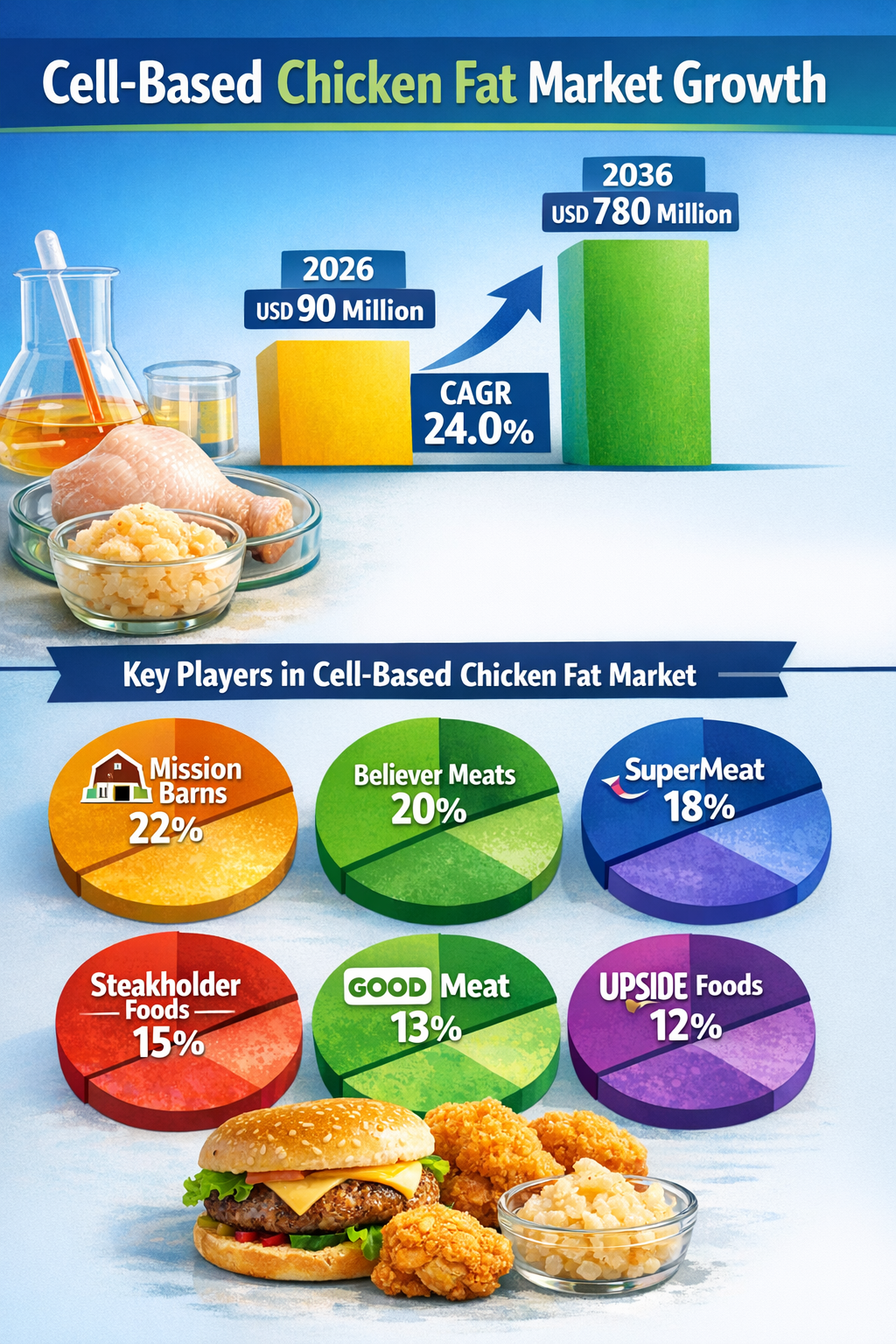
NEWARK, DE, UNITED STATES, March 4, 2026 /EINPresswire.com/ -- The global cell-based chicken fat market is entering a structural expansion cycle, surpassing a valuation of USD 73.0 million in 2025 and projected to reach USD 90.0 million in 2026. According to Future Market Insights (FMI), the industry is set to accelerate toward USD 780.0 million by 2036, reflecting a robust CAGR of 24.0% over the forecast period.
Absolute dollar growth of USD 690.0 million signals a decisive shift from pilot-scale novelty to regulated commercial ingredient trade. Food technologists are prioritizing cultivated avian lipids to address persistent sensory deficits in plant-based formulations, particularly around mouthfeel, aroma release, and cooking behavior.
Explore trends before investing – request a sample report today! https://www.futuremarketinsights.com/reports/sample/rep-gb-32149
Federal pre-market consultations completed in March 2025 across multiple avian and pork fat products reset ingredient qualification standards and strengthened procurement confidence. Regulatory clarity across North America has prompted procurement teams to consolidate supplier networks around companies holding established compliance portfolios.
Market Definition and Scope
Cell-Based Chicken Fat refers to commercially cultivated avian-derived lipids produced in controlled bioreactor systems. These lipids are supplied as functional food ingredients for hybrid meat products, plant-based protein upgrades, and alternative protein formulations. The market includes revenue generated from B2B manufacturing, licensing agreements, and structured supply contracts.
Excluded from the scope are conventional poultry fat, commodity tallow, plant oils, precision fermentation lipids not derived from avian adipocytes, and laboratory-only research output without commercial sales.
Market Value Trajectory and Economic Reset
The transition from pharmaceutical-grade growth inputs to food-grade growth factors is redefining unit economics. Media cost reductions below USD 0.20 per liter in 2025 are reshaping cost structures and improving scalability benchmarks.
However, regulators have simultaneously raised minimum safety thresholds, requiring legacy processors to secure approved cell lines and validated bioprocess documentation. This compliance gate is driving retrofit capital expenditure cycles across the industry.
As noted by Eitan Fischer, Founder and CEO of Mission Barns, a “fat-first” commercialization approach prioritizes taste and consumer acceptance before full muscle tissue parity. Capturing authentic lipid functionality allows producers to command premium margins even at limited production volumes.
Key Segment Insights
By Product Form (2026 Volume Share):
• Liquid/Rendered Fat – 38%
• Emulsified Systems
• Encapsulated Powder
• Plant-Lipid Blends
Liquid formats dominate due to extrusion compatibility and elimination of secondary spray-drying costs. Manufacturers favor direct integration into existing hardware to avoid thermal degradation and reduce overhead expenses.
By Application (2026 Share):
• Cultivated Meat Products – 46%
• Hybrid Meats
• Flavor Enhancers
• Functional Ingredients
• Pet Nutrition
Hybrid formulations are emerging as near-term revenue drivers, enabling brands to blend limited cultivated fat volumes with plant protein bases while preserving flavor authenticity.
Country-Level Growth Outlook (CAGR 2026–2036)
• United States – 26.8%
• Germany – 25.7%
• Netherlands – 25.0%
• Singapore – 24.5%
• China – 23.8%
• United Kingdom – 23.5%
The United States leads commercialization momentum following federal consultation completions and USDA clearances for large-scale facilities. Regulatory pathways have strengthened investor confidence and unlocked procurement budgeting cycles.
Germany and the Netherlands benefit from government-backed cellular agriculture consortia and structured innovation clusters. In Asia-Pacific, Singapore continues to serve as a regulatory launchpad, while China integrates cultivated protein targets into national development strategies.
Drivers, Restraints, and Strategic Opportunities
Primary Growth Catalyst:
Persistent sensory limitations in conventional plant-based foods are pushing formulators toward authentic animal lipid integration.
Scaling Barrier:
High bioreactor capital expenditure and recombinant growth factor costs limit tonnage availability and delay price parity with conventional poultry fat.
Strategic Levers for Executives:
• Prioritize hybrid product commercialization to stretch limited supply
• Secure long-term off-take agreements with established plant-based brands
• Invest in media recycling and cost-suppression technologies
• Repurpose stranded fermentation assets for accelerated scaling
Bioreactor capacity expansion toward 20,000-liter systems globally signals readiness for broader retail rollouts, though consistent positive unit economics remain a gating factor for institutional capital deployment.
Competitive Landscape
Regulatory clearance velocity now functions as the primary competitive differentiator. Companies with validated dossiers navigate multi-jurisdictional approvals faster and attract multinational food partnerships.
Key players shaping the competitive ecosystem include:
• Mission Barns
• Believer Meats
• SuperMeat
• Steakholder Foods
• GOOD Meat
• UPSIDE Foods
In February 2025, Stamm partnered with SuperMeat to commercialize automated bioreactor systems targeting 2026 launches. Later in November 2025, SuperMeat reported cost parity achievements of USD 11.79 per pound at scale, signaling measurable progress toward commercial viability.
Intellectual property surrounding immortalized avian cell lines and specialized bioreactor hardware is increasingly driving merger and acquisition activity, with legacy meat processors acquiring startups to absorb patented cultivation platforms.
Analyst Perspective
Nandini Roy Choudhury, Principal Consultant for Food & Beverage at Future Market Insights, states that sensory authenticity remains the structural growth catalyst. Companies executing fat-first commercialization strategies are best positioned to unlock near-term hybrid meat demand while scaling toward full tissue parity.
Why FMI: https://www.futuremarketinsights.com/why-fmi
Browse Related Insights
Polyols Market: https://www.futuremarketinsights.com/reports/polyols-market
Nutritional Labelling Market: https://www.futuremarketinsights.com/reports/nutritional-labeling-market
Demineralized Whey Powder Market: https://www.futuremarketinsights.com/reports/demineralized-whey-powder-ingredient-market
Dietary Supplement Market: https://www.futuremarketinsights.com/reports/dietary-supplements-market
Seed Coating Material Market: https://www.futuremarketinsights.com/reports/seed-coating-material-market
Sudip Saha
Future Market Insights Inc.
+ +1 347-918-3531
email us here
Legal Disclaimer:
EIN Presswire provides this news content "as is" without warranty of any kind. We do not accept any responsibility or liability for the accuracy, content, images, videos, licenses, completeness, legality, or reliability of the information contained in this article. If you have any complaints or copyright issues related to this article, kindly contact the author above.
